
Speeches
Ministerial Statement by Coordinating Minister for Public Services, Mr Chan Chun Sing, at the Government's Response to the '2026 Review of Salaries for Political Appointment Holders and Members of Parliament'
8 September 2026
Mr Speaker, Sir
Distinguished Members of Parliament
Mr Speaker, Sir, I will set out the details of the Government's Response to the 2026 Salary Review Committee's report.
SECURING A STRONG TEAM FOR SINGAPORE
Sir, as the Prime Minister has explained, this review is fundamentally about giving ourselves a better chance to build a first-rate team to serve Singapore and Singaporeans.
We need to ensure that the salary framework stays updated so that capable and committed people from different backgrounds and at different stages of life, can step forward to serve, not just the financially independent ones or those who have made exceptional lifestyle choices. That includes younger Singaporeans in their 30s and 40s, who may be building their careers, raising families and taking on major financial commitments.
We want such people to be able to enter public office in their prime – with the energy and runway to build up the experience, judgment to make tough decisions, and to bond and build up the trust with Singaporeans to take Singapore forward, especially in difficult times. This includes those who are more established in their careers, especially in the private sector. As the Prime Minister has said, some CEOs of major Singapore companies earn 6 or 7 million dollars a year, sometimes more. We are not trying to match that. Nor should we. But we cannot pretend that such opportunity costs do not exist. So we want to be able to say to capable Singaporeans, "Singapore needs you, and while political service involves sacrifices, it will not come at an unreasonable cost to you and your family".
At the same time, money must never be the primary motivation for anyone who enters political service. If money is your main reason for wanting to be a Minister, frankly, you are not the person we are looking for.
We will never be able to match the pay of all the people we hope to get. On the other hand, no matter how much we pay, some will never join for various reasons.
This is why we need a balance – a framework that is fair to widen the pool of Singaporeans who can realistically consider serving, while preserving the ethos of political service. The current framework was established in 2012, when the Government accepted the recommendations of the committee led by Mr Gerard Ee.
The recommendations were implemented retrospectively from May 2011, when the Government of the day took office. Since then, the political reference salaries have not been updated.
In 2017, the Government decided not to proceed with adjustments after an independent review because of prevailing economic circumstances. We further held back a review in 2023 and hence, the result is that the structure of political salaries has been frozen for 15 years. If we continue to hold off updates, we risk the framework losing its relevance. More importantly, we continue to weaken our ability to build a strong, diverse team of leaders that Singapore needs.
As part of the review process, the Prime Minister convened an independent committee in December last year.
After much deliberation, the Committee has submitted its report. With your permission, Mr Speaker, I have asked the Clerk to make the report on the '2026 Review of Salaries for Political Appointment Holders and Members of Parliament', available through the MP@SG Parl mobile application, and to be captured on the Official Report. With your permission, Mr Speaker, Sir, may I also display some slides on the LED screens as I walk the chamber through the reccs and our responses?
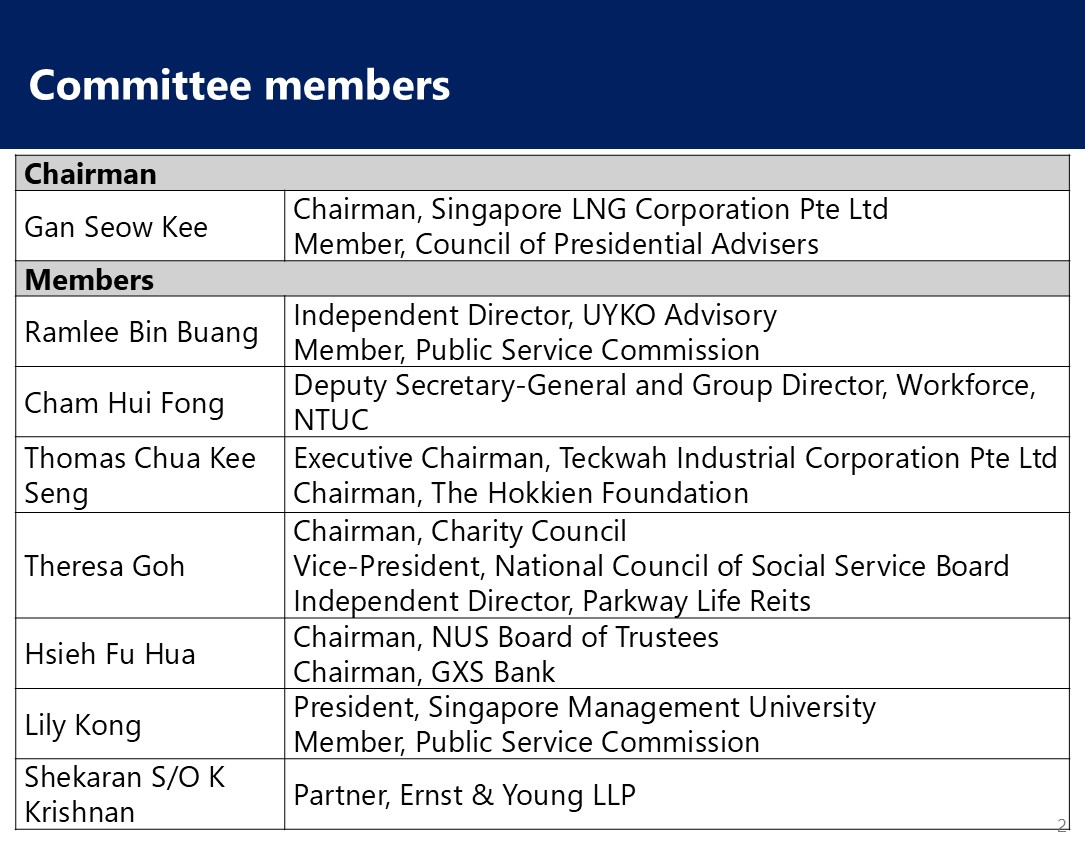
Mr Speaker Sir, I would like to put on record, our appreciation to the Committee led by Chairman Mr Gan Seow Kee, and comprising seven other members from across the private and people sectors. Their names are shown on the screen. This was not an easy task. The Committee approached it with seriousness, care, and rigour. The committee also engaged Mercer, a leading global HR consultant, for technical expertise and to provide additional information on pay practices and levels.
GOVERNMENT'S RESPONSE
Salary Levels
Principles Re-affirmed
Mr Speaker, Sir, before setting out the Government's Response to the Committee's recommendations, let me first set out the core principles that underpin the political salary framework. These principles were established by the 2012 Committee, affirmed by the 2017 Committee and re-affirmed by the 2026 Committee in their review.
The Government agrees with the Committee's assessment that the 3 core principles of the framework remain sound and necessary so that we can build a strong, sustained political core.
First, Calibre. The salary framework should take reference from market benchmarks to ensure individuals of the right calibre are not deterred from stepping forward to lead our country. Mr Speaker, Sir, the concept and carefully chosen phrase being "not deterred"; it is not "encouraged" or "attracted". This is to ensure that Singapore can continue to draw from a broad and deep pool of talent to serve in political office. Second, Commitment. The salary framework should include a meaningful discount relative to market benchmarks to reflect the ethos of political service. Today, the discount is 40% off the market benchmark, and this will continue. Third, a Clean framework. The salary framework should ensure a "clean wage" with no hidden perks. Transparency and integrity in remuneration remain fundamental to maintaining public trust.
In addition, the Government affirms that salaries should be clearly linked to performance – both individual and collective – based on outcomes that matter to Singaporeans and reflect socioeconomic progress.
Benchmark Formula Update
Sir, let me turn to the Government's Response to the Committee's recommendations on the benchmark formula and MR4 reference salary, underpinned by these principles.
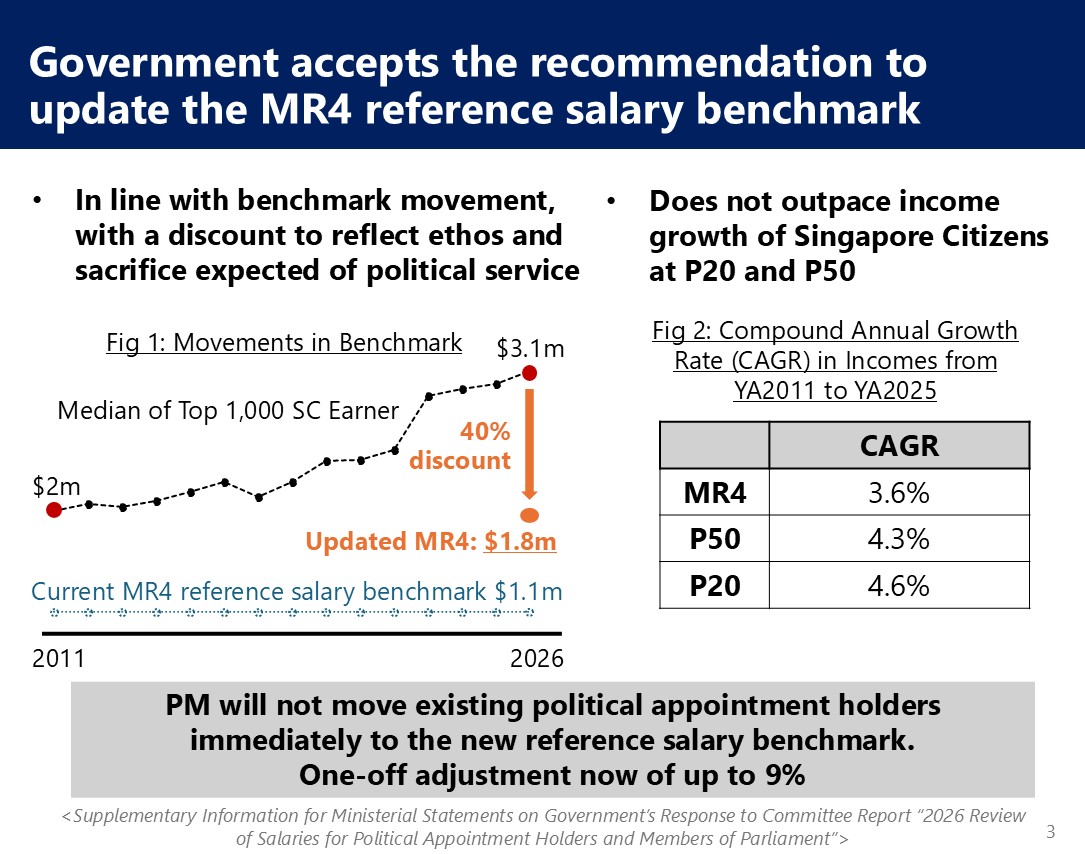
Sir, today, the benchmark salary formula for the MR4 grade is set at the median annual income of the top 1,000 Singaporean earners, with a 40% discount. The benchmark itself reflects the calibre of people Singapore needs for good governance, while the discount reflects the ethos of service. For context, as the Prime Minister has said, 10 out of 16 Ministers today serve at MR4.
For its review, the Committee carefully considered whether the benchmark formula itself, and the resultant reference salary, remain fair and sound. They examined the composition of the top 1,000 earners and affirmed that the benchmark pool continues to reflect a diverse talent pool, drawn from a wide range of sectors – manufacturing, healthcare, transport, hospitality, wholesale and retail, real estate, and financial and professional services. The benchmark pool also includes Singaporeans from a diverse range of occupations – not just the CEOs, but also others in management roles below CEO-level, and professionals across a range of fields.
The Committee studied the data and affirmed that using the median income, rather than the average income, of the benchmark pool is more prudent for computing the reference salary. The median is simply the middle value when all salaries are ranked from lowest to highest. Half earn above it, half below. Unlike the average, it is not distorted by outliers. A single ultra-high earner can pull up the average significantly, giving a misleading picture of what a typical person in the pool actually earns. Using the median avoids such outliers from skewing up the benchmark salary. They also went beyond affirming the philosophy of the formula. They looked at information across multiple sources and data from the private and people sectors to affirm the reasonableness of the latest salary benchmark.
Mr Speaker, Sir, let me be upfront. No formula will be perfect or able to satisfy everyone. There is no universally ideal benchmark. The key question is this – what is a workable framework and range of figures that allow the Prime Minister, any Prime Minister, to reasonably assemble a team that Singapore deserves?
After reviewing the report, the Government has decided to accept the Committee's recommendation to update the MR4 reference annual salary to $1.8m. The 40% discount remains. Without that discount, the reference for the median top 1,000 Singaporean earner would be slightly above $3m. This deliberate reduction reflects the ethos and sacrifice expected of political service. The difference between the current and new MR4 reference salary may seem significant to many.
But this is because the MR4 reference has not been updated for 15 years. Averaging over time, the adjustment works out to about 3.6% per year. Putting this into context, this is lower than the wage growth over the same period experienced by Singaporeans – about 4.3% annually for the median or P50 earner, and 4.6% for the lower‑income or P20 earner. For reference, over the same period, the Civil Service pay has been adjusted 3 times – once in 2014, another in 2022, and again in August this year. There were revisions ranging from 2% to 14%, calibrated to close the market gaps each time.
Sir, the benchmark is not a statement that only the top 1,000 earners can become leaders. It is a practical recognition that we must be able to recruit capable people who have other options.
Our objective is simple – to allow Singaporeans from every background to step forward and serve, while recognising that political service involves sacrifices.
Adjustment for Incumbents
As the Prime Minister has said, we will not move existing Political Appointment Holders immediately to the new reference salary. Instead, we will make a one-off adjustment of up to 9% for them, depending on individual circumstances, including performance and when his or her salary was last adjusted.
For an MR4 Minister who might be paid at the current reference salary of $1.1m, this means an increase to approximately $1.2m.
Beyond this immediate adjustment, any subsequent changes will be considered based on individual performance and responsibilities.
Salary Ranges and Grade Structure
Sir, let me now go into the Government's Response to the second set of Committee recommendations to streamline the grade structure for other Political Appointment Holders and widen salary ranges.
Salary Ranges to Cater for Diversity in Joiners
The Government has decided to accept the Committee's recommendation to widen salary ranges to 75% to 125% of the reference salary. The Committee noted that this is in line with market practice, where ranges are generally wider. Importantly, this gives greater room to cater for people joining political service from different backgrounds and at different stages of their careers.
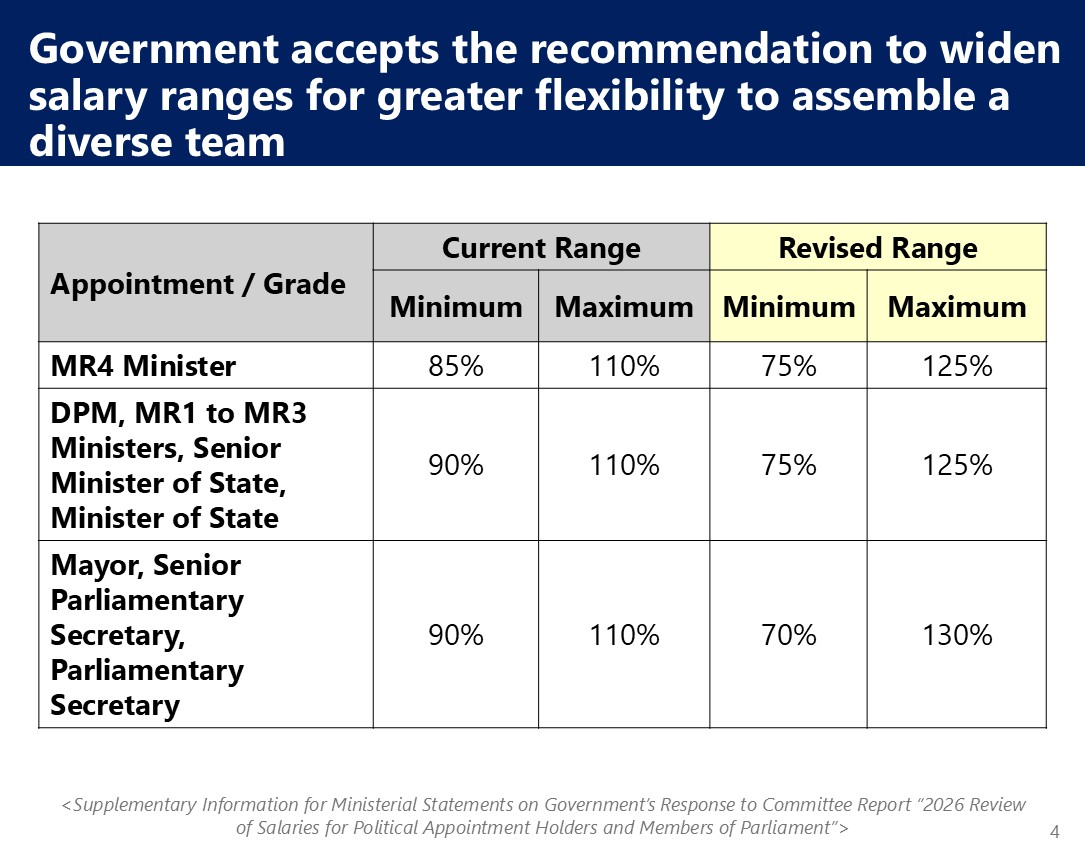
Today, the Prime Minister decides where each Political Appointment Holder should be placed within the relevant salary range, taking into account factors such as the person's experience, job scope, and previous remuneration package. As the Prime Minister has shared, a new Appointment Holder will typically start towards the lower-end of the range. Over time, the salary point can be adjusted based on the individual's performance and the responsibilities he or she takes on. At the same time, if we appoint someone who is already highly established in his or her career, we will have the flexibility to place the person higher within the range. The individual is still likely to have to take a pay cut to enter political service. But the wider range will help make the pay cut less steep.
Merged Grades
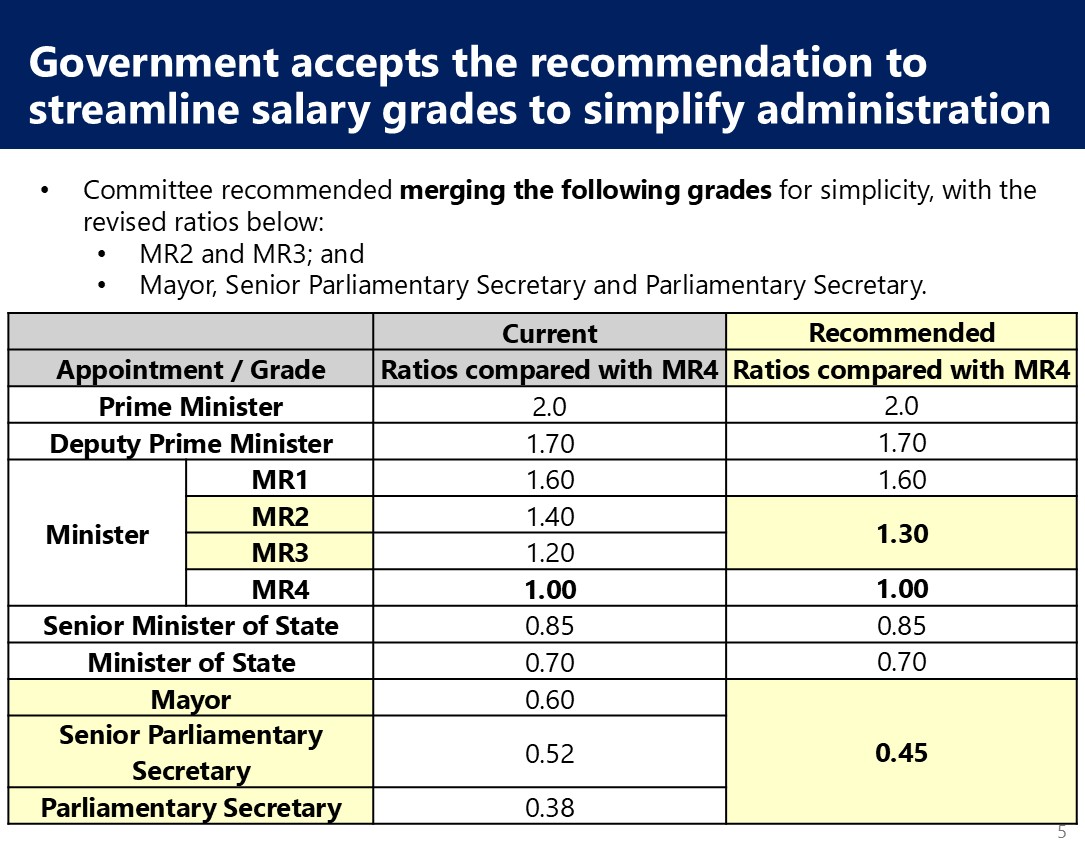
With wider salary ranges, the Government accepts the Committee's recommendation to streamline the grade structure for simplicity, and merge grades with fewer appointment holders. Specifically, we will combine the MR2 and MR3 Ministerial grades into a single grade, pegged at 1.3x of MR4. This is the midpoint between today's 1.2 and 1.4x of the MR4 reference salary. We will also merge and set the peg for Mayors, Senior Parliamentary Secretaries, and Parliamentary Secretaries at 0.45x of MR4. This is towards the lower end of today's range of between 0.38 and 0.6x. For this merged grade, a wider salary range of 70% to 130% of the reference salary will apply. This provides flexibility to cater for greater diversity among appointment holders in these grades.
Updated National Bonus Targets to Drive Better Outcomes
Mr Speaker, some have said that higher pay does not guarantee higher performance. This is true and precisely why we have not simply set an annual salary benchmark and left it there.
The salary paid to Political Appointment Holders comprises both fixed and variable pay components, with a split of about 65:35. What this means is that only about 65% of the annual MR4 reference salary is fixed and the remaining 35% is variable. Let me explain – this means that the fixed and variable components add up to the total reference salary. The variable components are not added on top of the entire package. This keeps salaries transparent and disciplined, while ensuring that performance and outcomes continue to matter. The variable components, which form part of (not on top of) the total annual salary, are paid depending on both individual performance, as well as national outcomes achieved based on a National Bonus framework.
Let me say a few words on how the National Bonus is structured. The National Bonus ranges from 0 to 6 months. It is tied to 4 indicators that reflect what matters most to Singaporeans – whether people have jobs, whether incomes are growing, especially for those at the median and lower rungs, and whether our economy is growing. The Government accepts the Committee's recommendations to revise the targets for the 4 indicators.
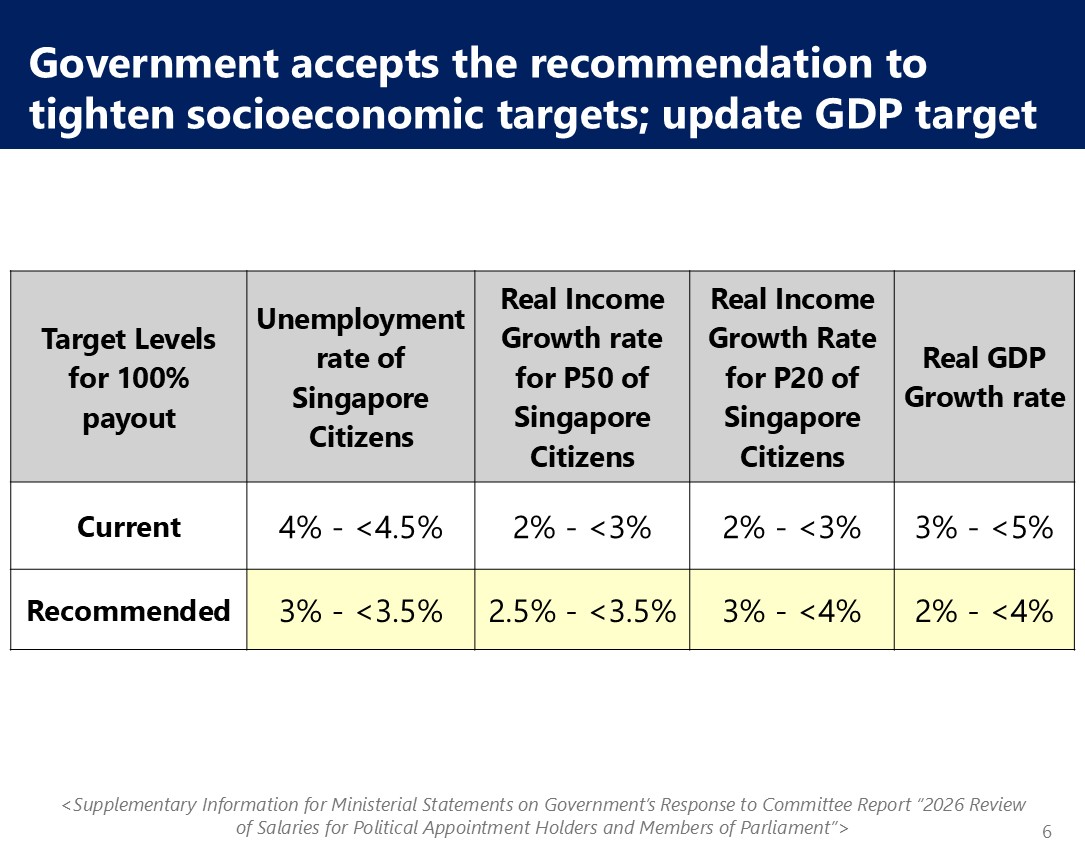
We will tighten the targets on all 3 socioeconomic indicators. Specifically, the Unemployment Rate, and Real Income Growth Rates of the P50 and P20 Singapore Citizen. For Unemployment Rate, the target level will be tightened from the current 4% to below 4.5%, to 3% to below 3.5%. This is a tightening of 1%. For the P50 Real Income Growth Rate, the target level will be tightened from the current 2% to below 3%, to 2.5% to below 3.5%. For the P20 Real Income Growth Rate, the target level will be tightened from 2% to below 3% to 3% to below 4%.
For Real GDP Growth Rate, the target band will be updated from 3% to 5%, to 2% to 4%. Over the past decade, our average growth rate has been about 2.6%. We have had some fortunate years recently, and MTI has upgraded the growth forecast to 4.5% to 5.5% for this year, reflecting the strong performance of our economy. However, our projection is that for our maturing economy, these are exceptional years rather than the norm.
Looking ahead, over the next decade, MTI expects our real GDP growth to be around 2% to 3% per annum, as a maturing economy, an ageing population and slower workforce growth, and all these will affect our long-term growth trajectory. Our responsibility is to set targets that are ambitious, credible and sustainable. That is why the Committee had calibrated the GDP growth indicator to Singapore's long-term growth potential, not the exceptional performance of specific years.
Beyond the immediate adjustments to the targets for existing indicators, the Government agrees to explore the inclusion of a robust Quality of Life measure in the National Bonus framework when this becomes available, as the Committee had suggested.
One Salary Despite Multiple Appointments
The Government also accepts the Committee's recommendation to retain the current practice of paying all Political Appointment Holders one salary package, even if they hold two or more appointments or portfolios. Sir, the principle is simple – one person, one salary. Holding more portfolios does not mean receiving more pay.
Statutory Appointment Holders
Sir, let me now move on to the recommendations for Statutory Appointment Holders.
President, Speaker, and Deputy Speaker
Sir, the Government accepts the Committee's recommendations to retain the existing approach for Statutory Appointment Holders, with clear and established pegs to the political salary framework. The President's monthly salary will continue to be pegged to the Prime Minister's monthly salary. The Speaker's salary will also continue to be pegged at 50% of the MR4 Minister reference salary. In turn, the Deputy Speaker's annual package will remain pegged at 15% of the Speaker's salary.
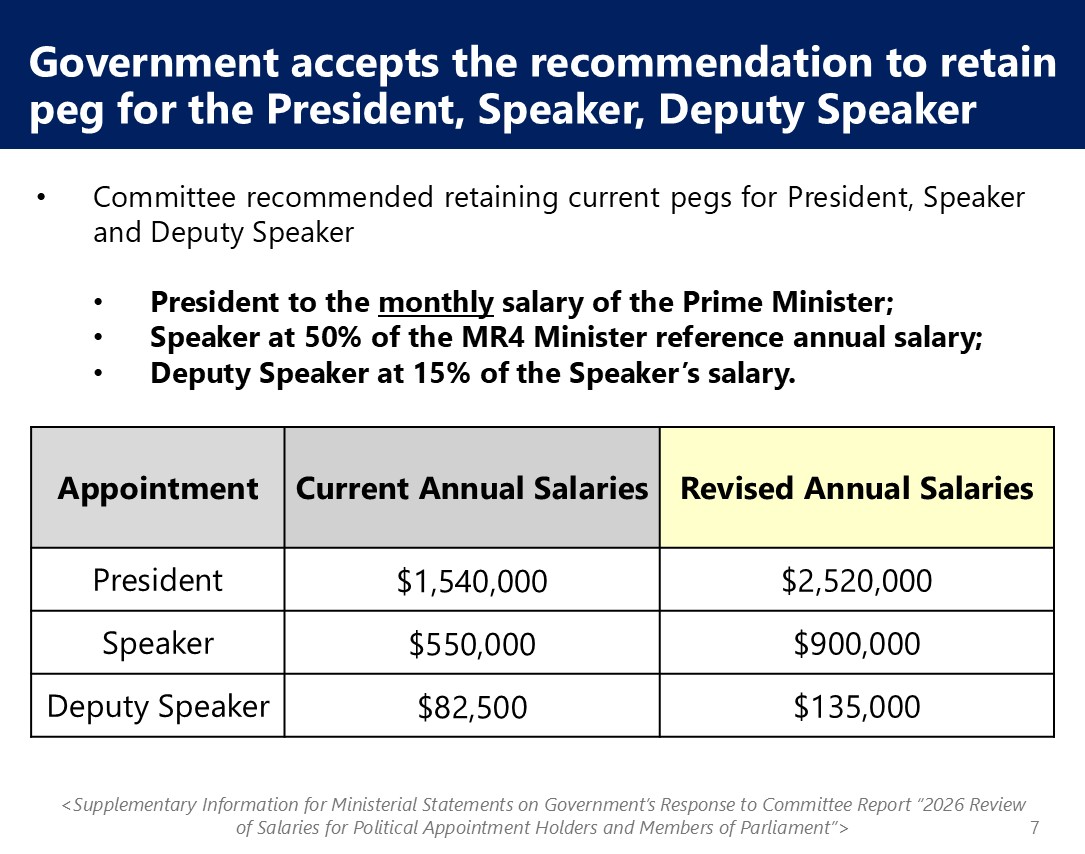
Beyond this adjustment, the Committee had recommended to study the peg for Speaker and Deputy Speaker, taking into account how their roles and responsibilities may have evolved over time. In particular, to consider whether their package might be better aligned with the formulation for the President's monthly salary. We will study the Committee's recommendations.
Salaries for the President, Speaker, and Deputy Speakers will be fully adjusted in line with the framework based on the updated MR4 reference salary, from 15 October. In October, the Government will move the necessary amendments and Motions to give effect to the adjustments for the President, Speaker and Deputy Speakers.
Other Changes
Sir, I will now touch on the remaining areas in the Government's Response related to Member of Parliament (MP) allowances.
MP Allowance Peg
MP allowances are currently pegged to 17.5% of the MR4 reference annual salary.
The Committee has observed that the considerations for community-related roles such as MPs and Mayors may differ from those for full-time Political Appointment Holders. It has recommended that the Government study establishing a basis for sizing the payments in a way that is delinked from the MR4 benchmark, but that remains adequate for these roles to carry out their duties faithfully and effectively.
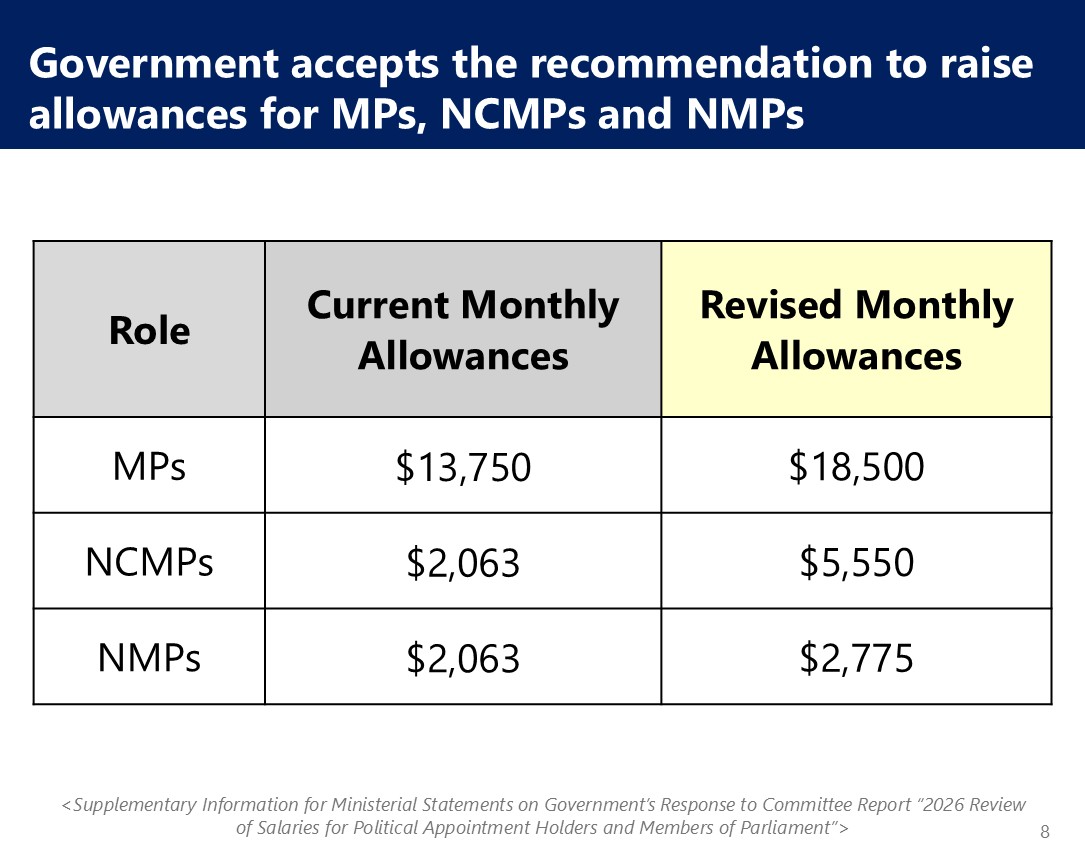
The Government will undertake such a study. In the meantime, the Government will accept the Committee's recommendation to update MP allowances from $13,750 to $18,500 monthly, to account for inflation. We accept the Committee's view that this references the 2012 Committee's earlier assessment that the level of MP monthly allowance was appropriate at the time. Updating the monthly allowance for inflation over the period is in line with this. This is a practical update to ensure that MPs are adequately supported in discharging their duties on the ground.
NCMP Allowance
The Government also accepts the Committee's recommendation to increase the allowance of NCMPs, from 15% of an MP's annual allowance, to 30%. This translates to $5,550 monthly. This considers the conferment of full voting rights to NCMPs since 2017, and brings the allowance into better alignment with their Parliamentary responsibilities.
For Nominated MPs, the Committee recommended to retain the peg for their allowances at 15% of the MP's allowance. The updated figure is $2,775 per month.
The revised allowances for all MPs will also be implemented with effect from 15 October.
Benefits
Finally, the Government accepts the Committee's recommendation to retain existing benefits provisions, which continue to uphold the principle of a clean wage, with no hidden perks, no pensions, and clear transparency. Medical benefits will continue under the Medisave-cum-Subsidised Outpatient (MSO) scheme, aligned with the Public Service.
Implementation Date and Future Reviews
Sir, as shared earlier, the Government will implement the adjustments within the framework with effect from 15 October 2026. The revised National Bonus framework will be implemented from 1 January 2027, as the data for the indicators are reported on a calendar year basis.
To keep the framework up-to-date along with changes in market and socioeconomic conditions, the Government also agrees that there should be regular, independent reviews of the salary framework every 5 years. Between reviews, where justified, the Government may make adjustments within the framework, and this will be exercised with responsibility and restraint.
Mr Speaker, Sir. There will be inevitable questions on how much more these recommendations will cost the Government. For illustrative purposes, the numbers are as follows: about $5m more annually, if the maximum of 9% is applied to all Political Appointment Holders; and about $6.6m more annually for all the Members of Parliament.
CONCLUSION
Mr Speaker, I have taken the House through the key points in the Government's Response.
Sir, this will always be a difficult topic to discuss, even in the best of times.
We understand the diverse concerns of Singaporeans. These are the very issues that Singaporeans expect the Government to deal with, and get right.
And precisely because these concerns matter, we must ensure that capable Singaporeans are not deterred from stepping forward to address them.
Even as we do so, we know that the contributions of Political Appointment Holders and MPs go well beyond pay. The opportunity costs and demands of public life away from families and loved ones are not something we take lightly. We cannot remove these sacrifices, but we can make the choice less prohibitive. And I want to thank all Members, past and present, from all sides of the House, who have stepped forward to serve nonetheless. Singapore is better for it.
For those considering political service, the question is not only whether the terms are fair, but whether this is a team worth serving with and this is a cause worth fighting for. That is a responsibility that falls on all of us. To inspire through our actions and sense of duty. To bring people together to discuss and work through difficult issues, rather than to divide by exploiting difficult issues for political gains. Let us all commit to do that for Singapore and Singaporeans.
Governing well means making clear-headed decisions for Singapore's long-term interests which may be uncomfortable today but necessary for tomorrow. This is what political leadership is about. Being upfront with our people on the challenges and options before us. Our principles and framework have not changed. What we are doing is updating salaries within that framework after a 15-year gap, so that they may remain relevant and disciplined.
Mr Speaker, Sir, this is how we do right by Singapore. This review is less about the individuals of today, who have already stepped forward to serve regardless. It is really about upholding a system that gives us a better chance for the next generation of capable and committed Singaporeans to step forward – so that Singapore's best days remain ahead of us.
NOTICE TO MOVE MOTION FOR DEBATE
With your permission, Mr Speaker, Sir, I have asked the Clerk to make the slides available through the MP@SG Parl mobile application.
Members will no doubt have views on the Government Response, and it is important that we hear them. That is why I will move a motion for this House to consider the statements made by the Prime Minister and myself. May I propose that any Member who wants to seek clarification do so during the debate. We look forward to the debate and will address any clarifications fully then.
To give Members some time to consider both Ministerial Statements made today, I give notice to move a Motion under Standing Order No. 44 for the Ministerial Statements, titled "Government's Response to the '2026 Committee Report on Review of Salaries for Political Appointment Holders and Members of Parliament'", to be considered by Parliament on Thursday, 10 September 2026. Mr Speaker, may I also request that this Motion be listed as the last item of business on the Order Paper before the adjournment of Parliament. Thank you, Sir.