Speeches
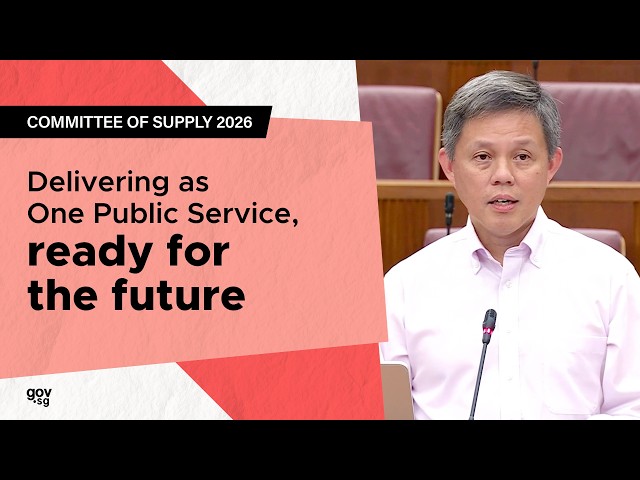
Speech by Minister Chan Chun Sing at the Committee of Supply Debate 2026
26 February 2026
Minister Chan was speaking in his capacity as Coordinating Minister for Public Services and Minister-In-Charge of the Public Service
ONE PUBLIC SERVICE, READY FOR THE FUTURE
1. Chair, I thank Members for their questions on how the Public Service will ensure we continue to meet the needs of Singapore and Singaporeans well.
2. Let me first address the cut by Mr Foo Cexiang on how we are preparing our public officers for tomorrow’s challenges. Indeed, the international order and our domestic landscape are fundamentally changing, and changing fast. Singapore must rethink our approaches and seize new opportunities to secure our place in the world.
3. To keep Singapore exceptional and ready for the future, I believe we must do three things well:
Understand the world well;
Understand our people well; and
Understand technology well.
Understand the world — this sharpens our clarity
4. First, understanding the world is vital to sharpen our clarity on how Singapore and Singaporeans can stay relevant in the new world. Given how small and open we are, everything in Singapore is affected by global developments elsewhere — from security to trade, to food and technology access. We need to make sound decisions for Singapore, and our officers must understand the new world that we operate in.
5. To help public officers build up their global exposure and connections, we are ramping up overseas postings and exchanges, attachments to international organisations, and stints in the private and people sectors. We also ensure Public Service leaders are globally informed and connected. Today, nearly four out of 10 officers on our central leadership development programmes have participated in programmes with structured overseas exposure.
6. By understanding the world, our public officers and leaders can better seize emerging opportunities and safeguard Singapore’s long-term interests.
Understand our people – this shapes our purpose
7. Second, we also need to understand our people and their expectations well. This will help to shape our purpose.
8. The work of the Public Service is not just to deliver transactions, but to build trust. Singaporeans want to be heard, to be involved, and to co-create solutions. Following the ForwardSG exercise, we have strengthened partnerships with citizens and communities through the Singapore Government Partnerships Office. In 2025, agencies received over 1,600 partnership proposals from citizens, corporates, community groups and organisations.
9. We also continue to make our services more accessible, inclusive and responsive. Today, 99% of Government-to-Citizen transactions – like CDC vouchers – can be completed digitally. Citizens who need help in person can visit ServiceSG centres, where they can access 600 services from over 25 agencies under one roof. To bring these integrated services closer to more residents, we have set up a 10th ServiceSG Centre in Ang Mo Kio this year.
10. To serve Singaporeans well, we must also invest in our officers. Mr Sanjeev Tiwari asked how public officers can have a meaningful, sustainable career within our Service. Last year, I announced the launch of a Career Fitness Movement for public officers to prepare for meaningful careers with increasing longevity. To date, more than 4,300 officers from over 69 public agencies have gone through the foundational programme under the Movement. Building on this momentum, we are introducing supplementary programmes to provide targeted support for officers at different career life stages. This is only possible through the strong support of our partners such as the Amalgamated Union of Public Employees (AUPE), which Mr Sanjeev heads.
11. Mr Sanjeev Tiwari also asked how the Public Service reinforces fair and timely resolution of any workplace concern. The Public Service is committed not only to invest in the career fitness of our officers but also recognise the importance of resolving early any workplace concern from our public officers. We have in place a Grievance Handling Procedure and Internal Disclosure Policy. These strive to ensure early resolution of any concern whilst maintaining confidentiality. We will continue to review them to ensure they remain relevant and effective, working in partnership with the unions.
12. On Mr Sanjeev’s question on the GRIT@Gov Programme, the Government is committed to invest in the skills of trainees. For trainees with an interest and aptitude to pursue a long-term career in the Public Service, we will also continue to invest in them as part of our Career Fitness Movement.
Understand technology – this strengthens our capabilities
13. Third, let me touch on technology. Understanding technology is an essential capability for every public officer and leader. Technological advancement – like Generative AI – is not a good-to-have but a must-have for all of us to thrive in the future.
14. Hence, we are enhancing our capabilities in science, technology and engineering across the Public Service, to improve how we deliver services. For example, all public officers are required to undergo compulsory digital and AI training, while digital training for senior Public Service leaders has accelerated over the past year. This goes to every level — from the Permanent Secretary to the last officer.
Delivering as One Public Service
15. Let me now conclude. To ensure Singapore is ready for the future, our Public Service will equip our officers to understand the world, understand our people, and understand technology.
Understanding the world will sharpen our clarity on how we can maintain Singapore’s relevance;
Understanding our people will shape our purpose and enable us to deliver for, and with, Singaporeans; and
Understanding technology will strengthen our capabilities and enable us to harness the latest advancements to be future-ready.
16. This is how we will continue to deliver as One Public Service, and keep Singapore exceptional for all Singaporeans.
17. Let me now address Ms He Ting Ru’s question on how the Prime Minister’s Office guides the use of Ministerial powers and discretion.
18. The Prime Minister assigns responsibilities to Ministers, including for statutory functions. All statutory functions must be exercised in accordance with the law.
19. The law confers discretion on Ministers and other officials so that they can exercise their judgement on how best to deal with each case based on the facts, instead of mechanically applying a rigid rule. The rationale for a discretionary function, its scope and limits, and any applicable safeguards, would have been debated by this House when the legislation was passed.
20. Each Minister is responsible for exercising the statutory functions assigned to him or her. The most important issues are referred to and discussed by Cabinet before a final decision is taken. Cabinet, in turn, is collectively responsible to Parliament.