Technology: Tech and AI helping officers work smarter and serve better.
If AI Was Your Intern
20 July 2026
What if AI joined your team as the newest intern? Through the eyes of a real-life intern, discover how AI can take on repetitive work, creating more time for learning, collaboration and better decision-making.
By Deon Ng, a real-life intern (with a little help from AI)
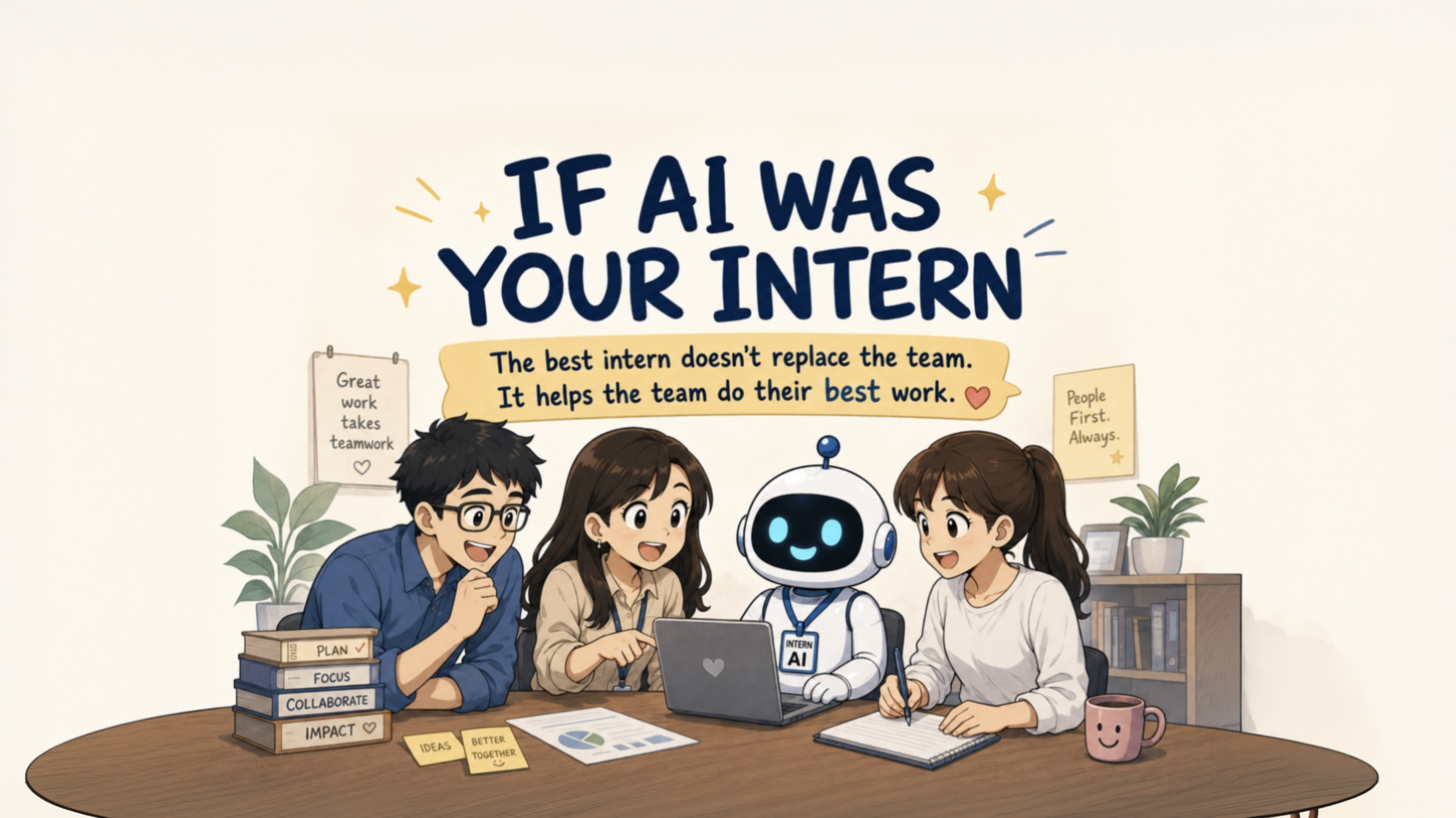
As a real-life intern, I've spent the past few months experimenting with AI. Some days, it's incredibly impressive. Other days, it's hilariously literal, or completely misses the point. The more I interacted with it for work, the more I realised something. AI didn't feel like a tool or a fully-functioning human -– it felt like...it could possibly be another intern.
Meet AI.
The latest addition to our team doesn’t survive on coffee but runs on prompts. As a fellow intern, AI was the eager one who volunteered for absolutely everything.
The one who always has an answer to everything in under two seconds.
The one who somehow finished a week's worth of work before lunch...
...but also created a 47-paragraph report when someone asked for "a quick summary".
That was the strange thing about AI. It never complained, never got tired, and never once asked whether the Wi-Fi password had changed. But it also doesn’t seem to empathise, understand why we are anxious over deadlines, or know how to read a room full of differing opinions.
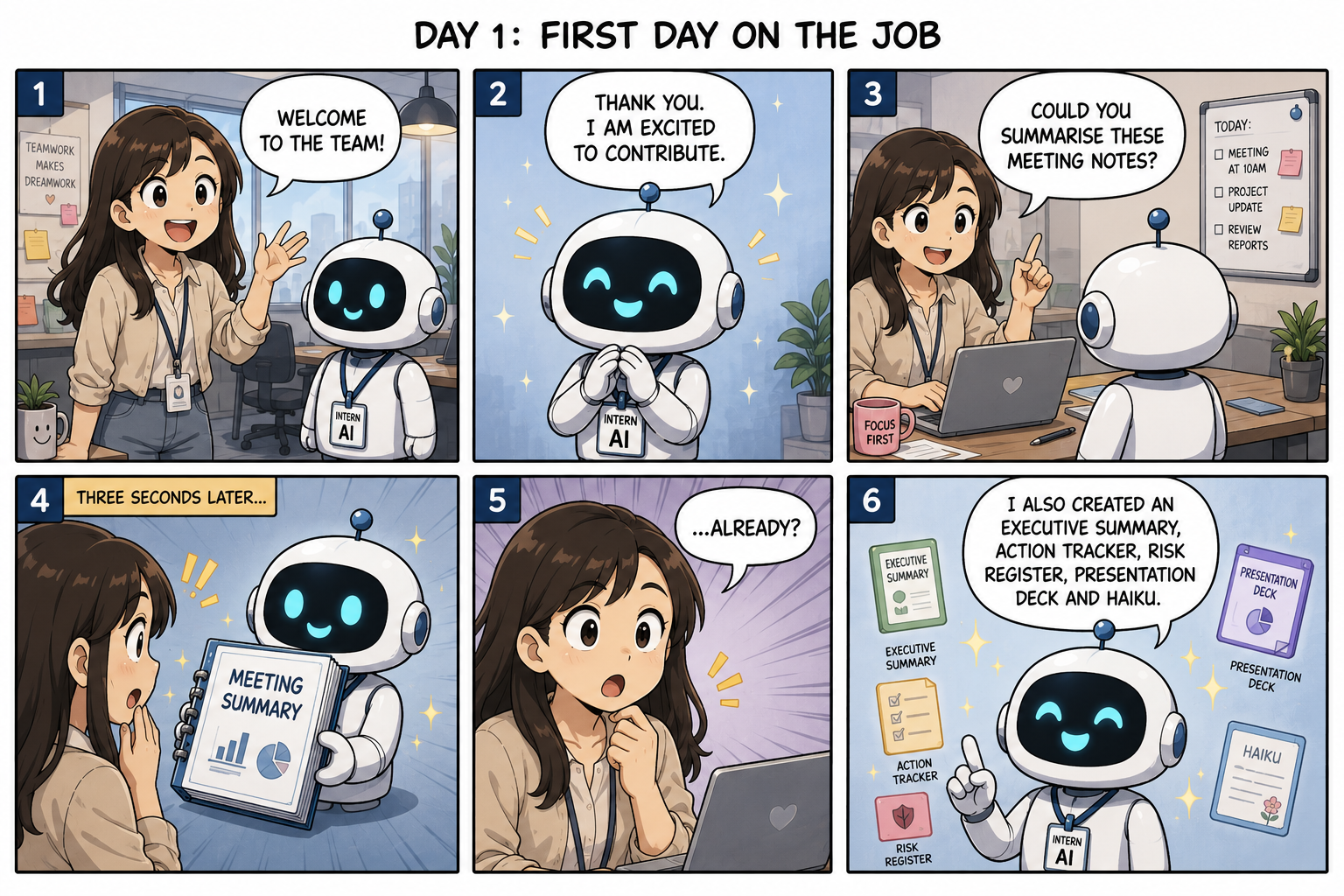
On its first day at work on the team’s project, routine tasks disappeared almost instantly. Meeting notes became summaries, messy spreadsheets became organised tables, and draft emails appeared before anyone had finished deciding who should write them.
The team wondered if they had accidentally hired the perfect intern. I wondered if I would be able to keep up with AI.
One day, someone asked AI to "make the report more exciting".
That turned out to mean adding three motivational quotes, five emojis, and a conclusion that sounded suspiciously like something from a superhero movie trailer.
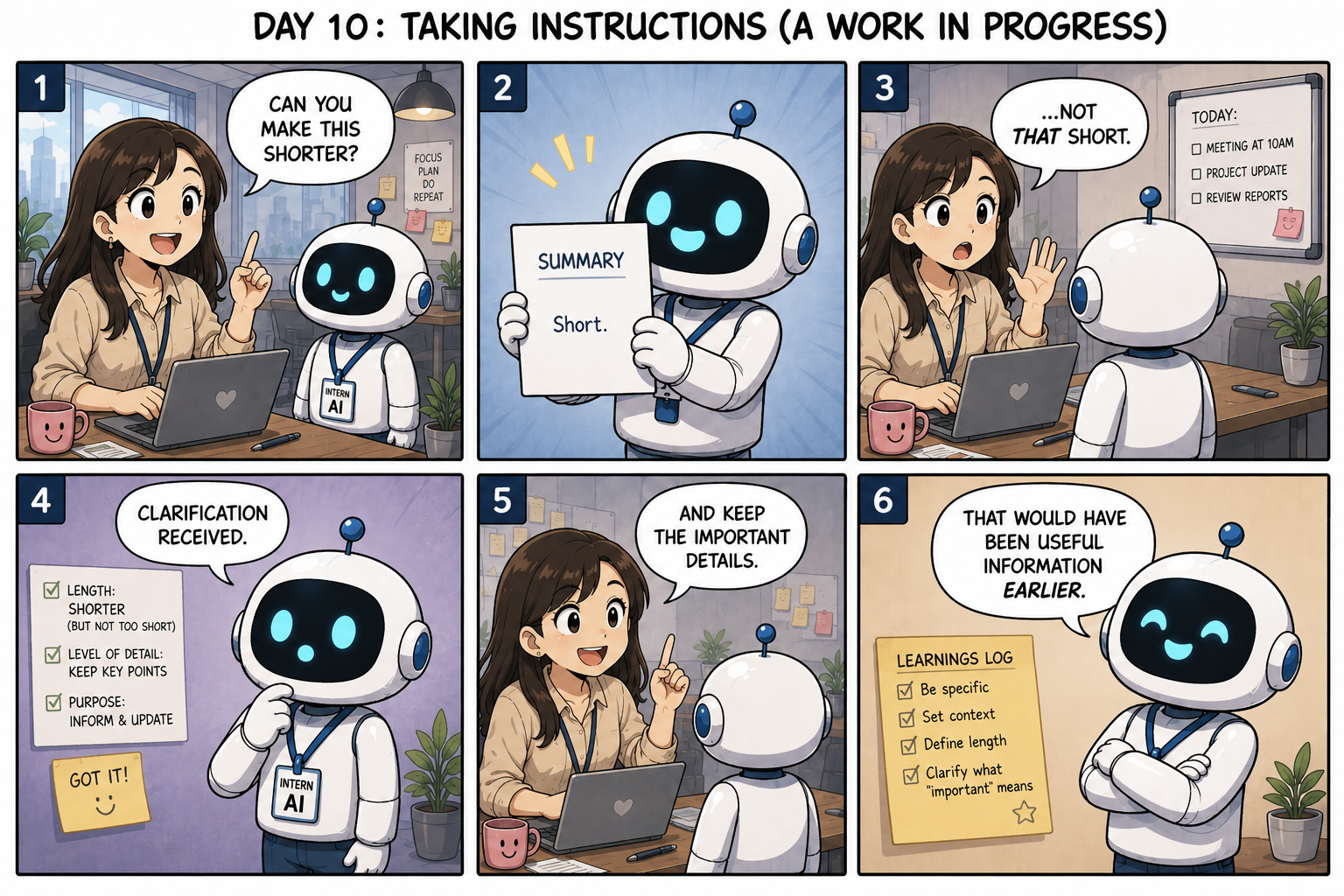
The team and I then realised an important truth.
AI wasn't bad at instructions. It was incredibly good at following them.
Sometimes...a little too well.
Ask it to "write something formal" and it might sound like a legal document. Ask it to "be creative" and suddenly your project proposal starts with a dramatic quote about humanity's future.
Ask vague questions? Receive surprisingly vague answers.
Eventually, everyone stopped giving simple, but intangible instructions like, "do this" or “do that”.
Instead, we learnt to explain, "Summarise these minutes for senior management in one page using plain English, and include a brief analysis on the collected data".
The results became significantly better.
Unlike a human intern, it wasn’t AI who changed. It was the team who did.
But there was still one more thing to learn.
The better our instructions got, the more convincing the answers became — even the wrong ones.
AI would hand us a confident summary, a tidy analysis, a clean recommendation... and sometimes quietly invent a figure, misread the context, or miss the one nuance that actually mattered.
It never sounded unsure. That was the problem.
So we learnt to discern.
Someone still had to ask, "Is this actually right?" We had to check the numbers, question the framing, and catch what AI didn't know it was missing.
AI could produce the work. But it couldn't be accountable for it.
That part stayed human.
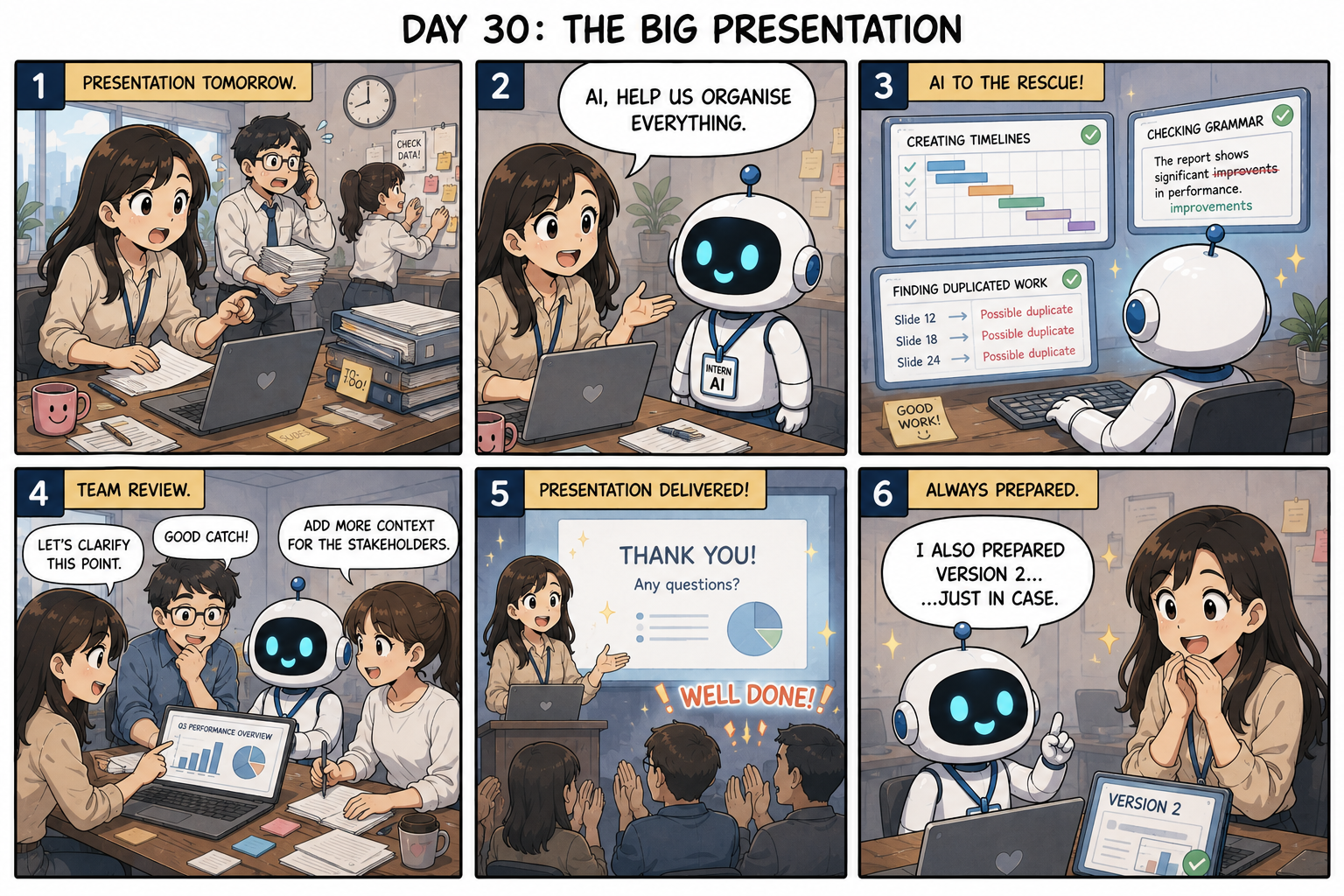
By the end of the project, everyone had learnt to work alongside AI, but nobody mistook it for the sole reason the team succeeded. It couldn't read nuance or tell when a stakeholder was being polite rather than agreeing. It couldn't replace experience, judgement or empathy.
As a real-life intern, that changed the way I saw AI too.
At first, I wondered whether AI would take away the kind of work interns usually do. Instead, I found that it changed the kind of work I got to do.
By spending less time on repetitive tasks, I had more time to ask questions, learn from colleagues and understand the thinking behind the work. That made me realise AI wasn't replacing the internship experience — it was creating more room for it.
That wasn't just true for me. It gave the entire team something even more valuable: time. Time to ask better questions, have better conversations, and think more deeply about the work, rather than simply getting through it.
The team's best results didn't come from handing everything to AI, or from pretending it doesn’t exist. They came from knowing what to delegate so that we could focus on the work that only people can do. It didn't just help us do work better; it freed us to do better work.
And the best internship isn't the one where you spend the most time on repetitive tasks. It's the one where you spend the most time learning, contributing and growing.
++++
This article was created with the assistance of AI. Edited, fussed over, and signed off by humans.