
Preparing for the Future: Ideas and projects preparing Singapore for what’s next.
Singapore Built Land Below Sea Level. Here is Why That Matters.
15 October 2026
At Pulau Tekong, Singapore’s first polder is turning a land-scarce nation’s constraints into capability—using less sand, automated water management systems, and close interagency collaboration to create new land while preparing for a more climate-uncertain future.
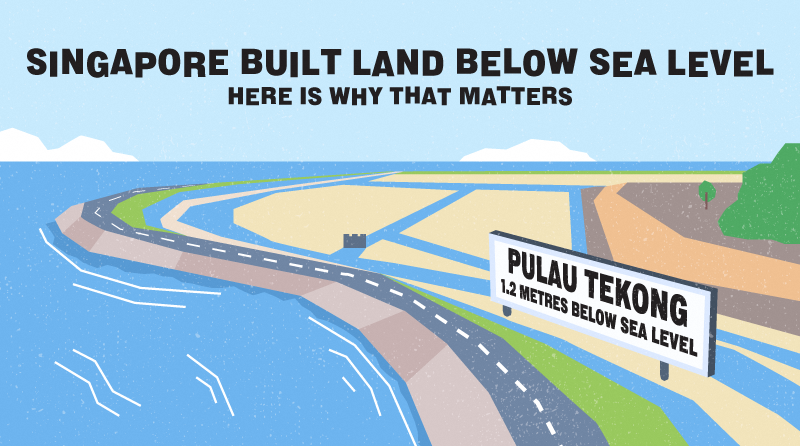
What if Singapore could create new land without simply piling sand into the sea?
That is exactly what has happened at Pulau Tekong.
At the north-western tip of the island, there is now a newly reclaimed plot of 800 hectares, the main construction works having been completed in 2025. The innovation? This site, which will be used for military training, lies 1.2 metres below sea level.
But the bigger story goes beyond Singapore having more land or freeing up more space on the mainland for homes and amenities. It is how this reclaimed land, called a polder, came to be.
Rethinking Land Reclamation
Singapore has been reclaiming land since the 1800s (opens in new tab). The usual approach is simple: enclose part of the sea and fill it with materials such as soil and sand till the new land rises above sea level. This approach would require a large amount of infill materials.
The Pulau Tekong polder marks a new, innovative direction.
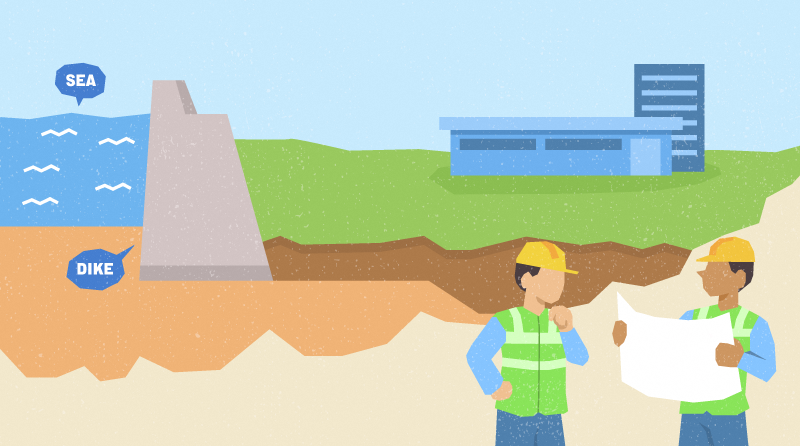
The coastal dike, standing at up to six metres above mean sea level, keeps the seawater out.
Led by Housing & Development Board (HDB), the project uses almost 50 per cent less sand compared with traditional reclamation. This presents a new way to think about growth: doing more with less and laying the groundwork for a more resilient future.
Holding Back the Sea, Keeping the Land Dry
Land lying below sea level cannot stay dry on its own. Keeping it usable requires serious engineering built around two essentials: a strong coastal dike and a comprehensive drainage system.
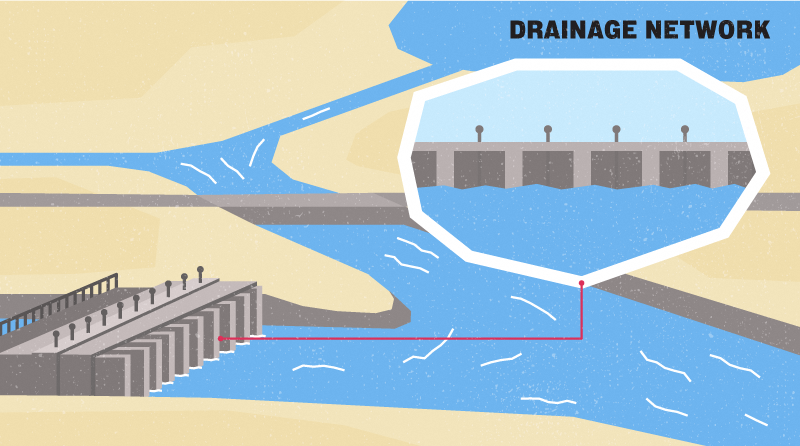
The 45km-long drainage network, which includes more than 30 water control, inlet, and outlet structures with multiple gates, regulate stormwater and maintains good water quality.
First, the coastal dike. This 10-kilometre structure, standing six metres above mean sea level at its highest point, runs around the reclaimed land. If sea levels rise in the future due to climate change, the dike can be raised further—making it not just a barrier, but a long-term investment in coastal resilience.
This is the first time Singapore has designed and built a coastal dike, so we drew on the expertise of the Netherlands, which has the world’s highest standards for dike safety.— Chua Wee Siang, Principal Engineer, HDB
“To minimise seawater seepage, there is an inner wall made of a special material called cement-bentonite. On the seaward side, natural rocks help absorb impact from waves,” Wee Siang adds. “We also planted Bermuda grass on the landward slope for its deep-reaching root system to hold the soil together and prevent erosion.”
Keeping the sea out is only half the job. Rainwater and any seawater that seeps through must be collected and pumped out.
A drainage network, a stormwater collection pond, and two pumping stations handle this. When it rains, water flows into the stormwater collection pond, large enough to hold the equivalent of about 2,000 Olympic-sized swimming pools, which is pumped out to sea when full.
The system does not run on guesswork. PUB, Singapore’s National Water Agency, monitors it remotely through over 170 CCTV cameras, more than 260 sensors, and an automated control system to keep the polder dry around the clock.
Innovating on the Go
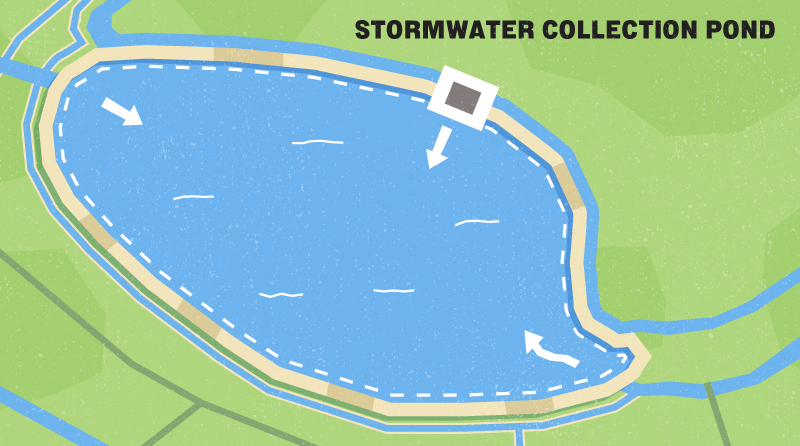
The drainage network diverts stormwater runoff into the stormwater collection pond.
The Pulau Tekong Polder may have drawn on Dutch experience but it was not just a matter of importing a proven model.
Singapore’s conditions are distinctly different. The island experiences generally milder wave conditions than much of Europe’s exposed coastlines but faces far more intense tropical rainfall.
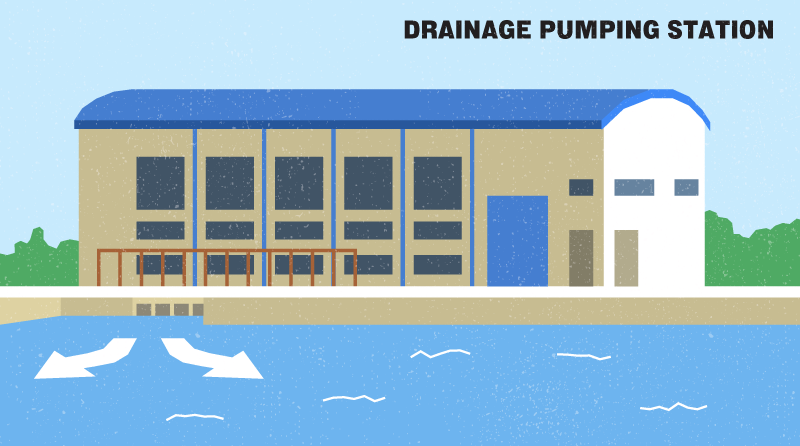
When the water level in the pond reaches a certain level, excess water is channelled into the Drainage Pumping Station and pumped out to sea.
Working closely with Dutch experts, HDB and PUB had to adapt polder technology to local conditions and solve engineering problems Singapore had never confronted at this scale.
A key challenge was a genuine Catch-22: how do you build water outlets below sea level before the dike that keeps the sea out is even finished?
“To overcome this, we constructed cofferdams, which are temporary watertight enclosures, using steel sheet piles,” Wee Siang explains. “These had to be driven into the seabed up to 26 metres deep, around the height of an eight-storey HDB block, to hold back the seawater and keep the construction areas dry till the dike was completed.”
The project also found value where others might have seen waste. More than 10 million cubic metres of clayey soil were dredged—enough to fill about 4,000 Olympic-sized swimming pools. Rather than dispose of it, HDB reused some as infill material for the polder.
There was just one problem: the soil was too soft and wet.
So the engineers firmed it up by inserting vertical drains into the soil and placing sand over it to create pressure. This squeezed the water upwards and out through the pipes, turning weak, soft soil into sturdy usable land.
A New Piece of Land, and a New Capability
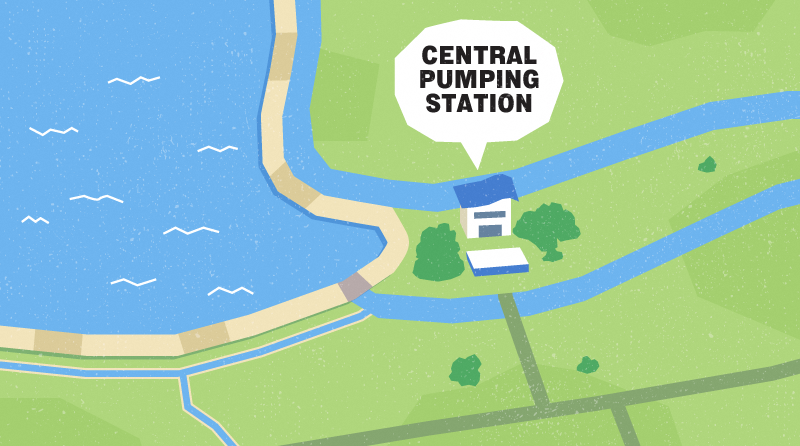
The Central Pumping Station draws water from the stormwater collection pond during dry weather and circulates it within the drainage network, helping to maintain water levels in the drain, ensure consistent groundwater level, and prevent stagnation to safeguard water quality.
Building Singapore’s first polder was not a solo effort. HDB led the design and construction works, PUB will oversee the water management system, and MINDEF will use the reclaimed land for future military training.
The gains extend beyond the land itself. Through the project, agencies deepened their capabilities in interagency coordination and polder development.
“This project marks a significant engineering milestone,” says Wee Siang. “We have gained valuable experience in designing and building a coastal dike, a complex water management system below sea level, and repurposing soil to reduce sand use. These capabilities will help Singapore in future land reclamation and coastal protection works.”
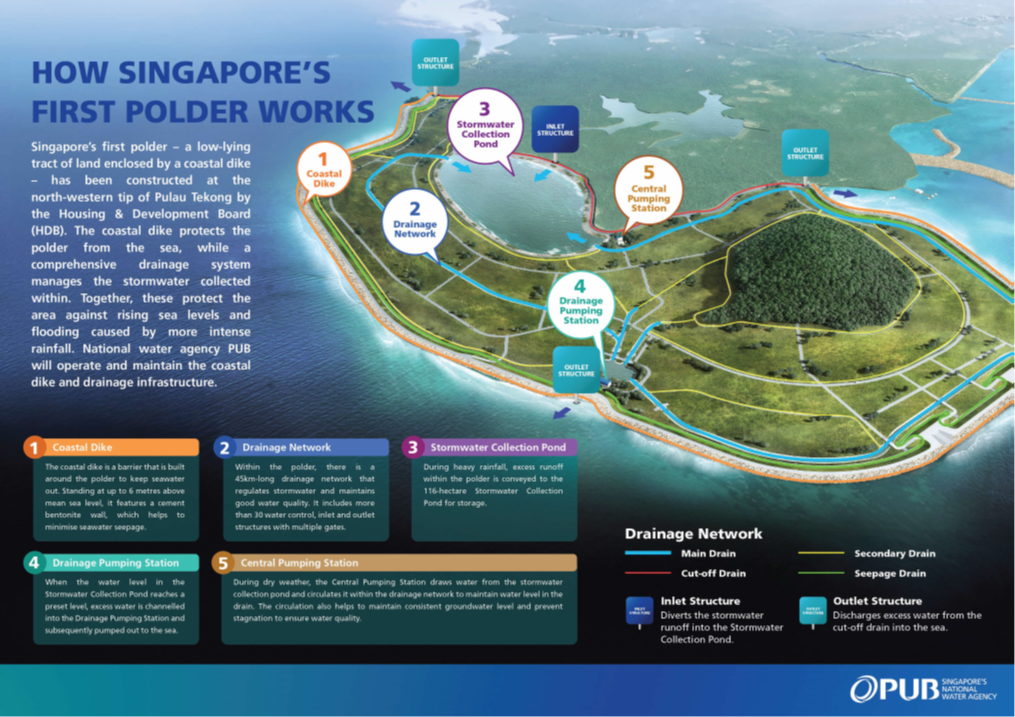
How Singapore's first polder works - courtesy of PUB.